
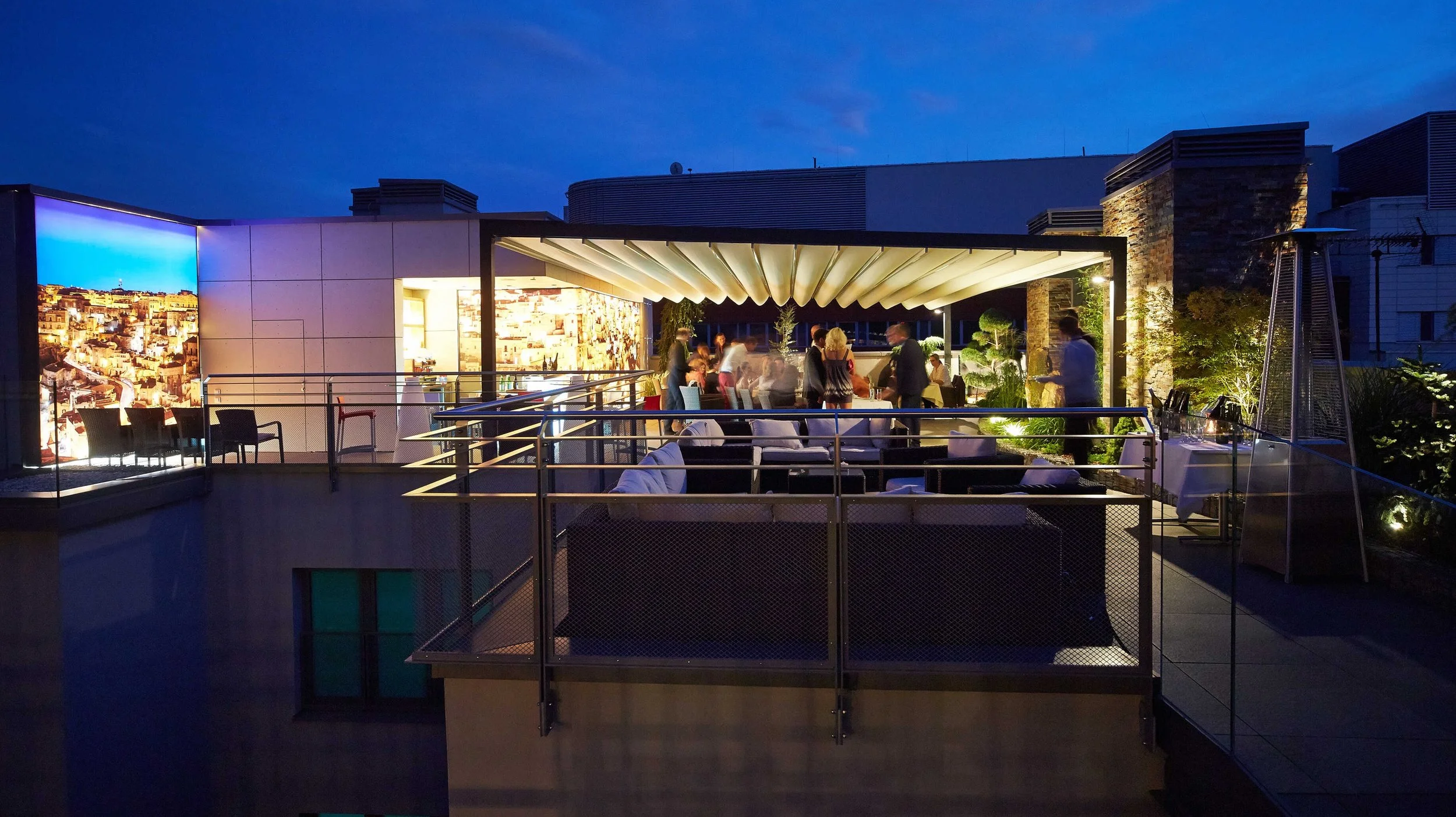
The Hospitality Operator's Guide to All-Weather Alfresco Systems — Brisbane 2026
The Hospitality Operator's Guide to All-Weather Alfresco Systems — Brisbane 2026
A practical comparison of retractable roofs, motorised louvre systems, folding arm awnings and pergola structures for Queensland restaurants, cafés, hotels and entertainment venues.
Restaurant OwnersCafé OperatorsHotel & Resort ManagersLicencees
Architects & Fit-Out Managers
Commercial Developers
1. The Real Cost of an Unprotected Alfresco Area
Brisbane's subtropical climate is your biggest commercial variable. A single afternoon storm can clear your outdoor dining area in minutes. A hot, unshaded terrace empties before the lunch service peaks. A damp, exposed space in winter loses bookings before the phone rings.
For most Brisbane hospitality venues, the outdoor alfresco area represents 20–40% of total seat capacity. Left unprotected, that capacity is weather-dependent — which means revenue-dependent on conditions you cannot control.
A simple revenue calculation
Assume a 40-seat alfresco area at $65 average spend per person, two sittings per service:
$5,200
lost per rain-affected service
At 20 affected services per year — a conservative estimate for Brisbane's wet season — that's $104,000 in annual revenue at risk. A properly specified all-weather system typically pays back within 12–24 months on this basis alone.
The question is not whether to protect your alfresco area. The question is which system is right for your venue, your design, and your budget.
2. Your Four Main System Options
Brisbane hospitality venues have four primary system types to consider. Each has a different function, price point, weather capability and aesthetic. This guide compares all four so you can make an informed specification decision before calling a supplier.
Retractable Fabric Roof Systems
A motorised fabric roof on a structural frame that opens and closes on demand. When closed, a properly pitched retractable fabric roof provides reliable waterproof coverage. When open, the space becomes fully alfresco. The system disappears into a cassette housing when retracted, keeping the open-sky aesthetic. Best suited to venues that want maximum flexibility between fully open and fully protected.
Motorised Louvre Roof Systems
Adjustable aluminium blades (louvres) on a permanent aluminium frame. Louvres rotate to control light, shade, airflow and rain protection. They do not fully retract — the structure is always visible — but the adjustability gives hospitality venues fine control over the environment. Premium bioclimatic louvre systems can cover very large spans and link endlessly to cover entire terraces or rooftop areas.
Folding Arm Awnings
Wall or soffit-mounted fabric awnings that extend on articulated arms. Excellent for sun and glare control. Cost-effective for smaller installations and street-side cafés. Not suitable as a primary waterproof solution for a commercial dining area — see Section 3 for the specific reason most venues get this wrong.
Pergola Structures with Integrated Roof
A permanent structural pergola frame fitted with either a retractable fabric roof or a motorised louvre roof. Suited to venues creating a defined outdoor room — a permanent architectural addition to the space. Higher upfront investment, stronger aesthetic result.
3. The Most Common Mistake Brisbane Venues Make
Industry Insight — Read Before You Specify
Folding arm awnings are not a waterproof solution for outdoor dining
The single most common specification mistake we see in Brisbane hospitality is installing folding arm awnings as the primary weather protection for an outdoor dining area. The initial cost is lower, and the fabric itself may be technically waterproof — but the system fails in practice for one specific reason.
Water does not drain off a folding arm awning cleanly. In a Queensland downpour, water pools on the fabric, then runs off the leading edge and splashes outward — losing approximately one metre of dry surface area on each side of the awning. For a 6-metre wide awning, you lose 2 metres of usable dry space. Tables near the edge get wet. Guests move inside. The awning has failed its primary commercial purpose.
Folding arm awnings are excellent products in the right application: sun and glare control for street-side cafés, supplemental shade over specific zones, or residential patios where waterproofing is not the primary requirement.
For a genuine all-weather alfresco dining solution, you need either a retractable fabric roof system with positive drainage pitch, or a motorised louvre roof system.
| Feature | Retractable Fabric Roof | Motorised Louvre Roof | Folding Arm Awning | Pergola + Integrated Roof |
|---|---|---|---|---|
| Fully waterproof | ✅ Yes — when closed | ✅ Yes — louvres sealed | ❌ No — splash-off at edges | ✅ Yes — depends on roof type |
| Fully open-sky option | ✅ Yes — fabric retracts | ⚠️ Partial — frame remains | ✅ Yes — arms retract | ⚠️ Partial — frame permanent |
| Ventilation control | ⚠️ Open or closed only | ✅ Full blade adjustment | ⚠️ Open only | ✅ Depends on roof type |
| Wind rating (extended) | Up to 100 km/h | Up to 100 km/h+ | Up to 40 km/h | Up to 100 km/h+ |
| Large span capability | ✅ Yes | ✅ Yes — linkable modules | ⚠️ Limited | ✅ Yes |
| Aesthetic flexibility | ✅ High | ✅ High | ⚠️ Moderate | ✅ Very high |
| Motorisation | ✅ Standard | ✅ Standard | ✅ Available | ✅ Standard |
| Smart sensor integration | ✅ Wind + rain sensors | ✅ Wind + rain + sun | ✅ Wind sensor recommended | ✅ Full integration |
| Engineering certification | ✅ Yes — per installation | ✅ Yes — per installation | ✅ Yes — per installation | ✅ Yes — per installation |
| Recommended for commercial dining | ✅ Yes | ✅ Yes | ❌ Sun only — not waterproof | ✅ Yes |
| Commercial price range (installed) | $50,000–$150,000+ | $50,000–$150,000+ | $10,000–$30,000 | $60,000–$200,000+ |
4. System Comparison — Head to Head
Prices are indicative for commercial Brisbane installations. Final cost depends on area size, structural requirements, motorisation, and site conditions. All Awning Scape installations include engineering calculations and documentation.
5. Brisbane Climate: What Your System Must Handle
Queensland UV intensity
Brisbane receives some of the highest UV radiation levels in the world. Commercial fabrics specified for Queensland outdoor dining must meet AS/NZS 4399 UPF 50+ compliance — the Australian standard for sun-protective performance. Awning Scape specifies only premium European fabrics from Serge Ferrari, Dickson, Sattler and Mehler, all of which meet or exceed this standard. Budget-grade fabrics degrade faster under Queensland UV, losing both colour and structural integrity.
Subtropical storms and afternoon downpours
Brisbane's wet season brings sudden, high-intensity afternoon storms — often peaking between 2pm and 6pm during the summer service window. A system rated for Queensland conditions must handle not just sustained rain but sudden gusts that accompany these events. Awning Scape retractable roof systems carry wind ratings of up to 100 km/h in the extended position — significantly above standard market ratings — with higher ratings when fully closed or retracted.
Humidity and ventilation in summer
A fully enclosed outdoor dining area in a Brisbane summer can become uncomfortable quickly. Motorised louvre systems have a significant advantage here — blade adjustment allows maximum airflow on humid evenings while maintaining shade. Many hospitality venues in Brisbane opt for a louvre roof paired with retractable side screens, giving full environmental control across all seasons.
Winter use and heat retention
Brisbane winters are mild but cool enough to deter outdoor dining without some enclosure. A closed louvre or retractable fabric system combined with infrared heating extends the outdoor season year-round — turning what would be an empty terrace in June and July into a warm, atmospheric dining space.
6. Wind Ratings Explained in Plain Language
Wind ratings matter most during a Brisbane afternoon storm. All Awning Scape systems are supplied with engineered wind calculations per installation — not blanket manufacturer claims. Queensland Form 15 and Form 12 construction compliance certificates are available on request.
The European Standard EN 13561 is the baseline wind classification used to test premium shade systems in the Australian market. Here is what each wind class means for your venue:
| Beaufort Scale | Wind Speed | Conditions | Folding Arm Awning | Retractable Roof / Louvre |
|---|---|---|---|---|
| Force 3–4 | 12–28 km/h | Light breeze to moderate breeze | 🟢 Safe — can operate | 🟢 Safe — can operate |
| Force 5 | 29–38 km/h | Fresh breeze — leaves in motion | 🟡 Caution — retract soon | 🟢 Safe — can operate |
| Force 6 | 39–49 km/h | Strong breeze — Brisbane storm onset | 🔴 Retract immediately | 🟢 Safe — engineered for this |
| Force 7–8 | 50–74 km/h | Near gale — strong storm gusts | 🔴 System at risk of damage | 🟡 Within rating — monitor |
| Force 9–10 | 75–102 km/h | Severe storm | 🔴 Do not use | 🟡 At or near rating limit |
Smart Sensor Note
Awning Scape recommends automated wind sensors on all commercial installations. These retract or close the system automatically when wind speeds exceed the safe operating threshold — protecting both the system and your guests without manual intervention during a fast-moving Brisbane storm.
7. Commercial Pricing Guide
Every Awning Scape project is solution-based — the right system for your site, your structural constraints, and your design intent. The following ranges reflect typical Brisbane commercial installations and should be used as a planning guide. A precise quote requires a site visit and design consultation.
Retractable Fabric Roof
$25K+
Commercial installation, from 30sqm. Price scales with area and structural requirements.
Motorised Louvre Roof
$50K+
Commercial installation. Bioclimatic systems scale to large linked configurations.
Folding Arm Awnings
$10K+
Sun and glare control. Multiple motorised units for wider areas.
Pergola + Integrated Roof
$60K+
Full structural outdoor room. Premium finish installations from $100K+.
All prices are installed, including engineering documentation. Manufacturing lead time is 6–8 weeks. Installation typically requires 1–2 days for retractable roof systems. Prices exclude optional additions such as integrated LED lighting, infrared heaters, automated screens, and smart home integration.
Why Awning Scape systems cost more than budget alternatives
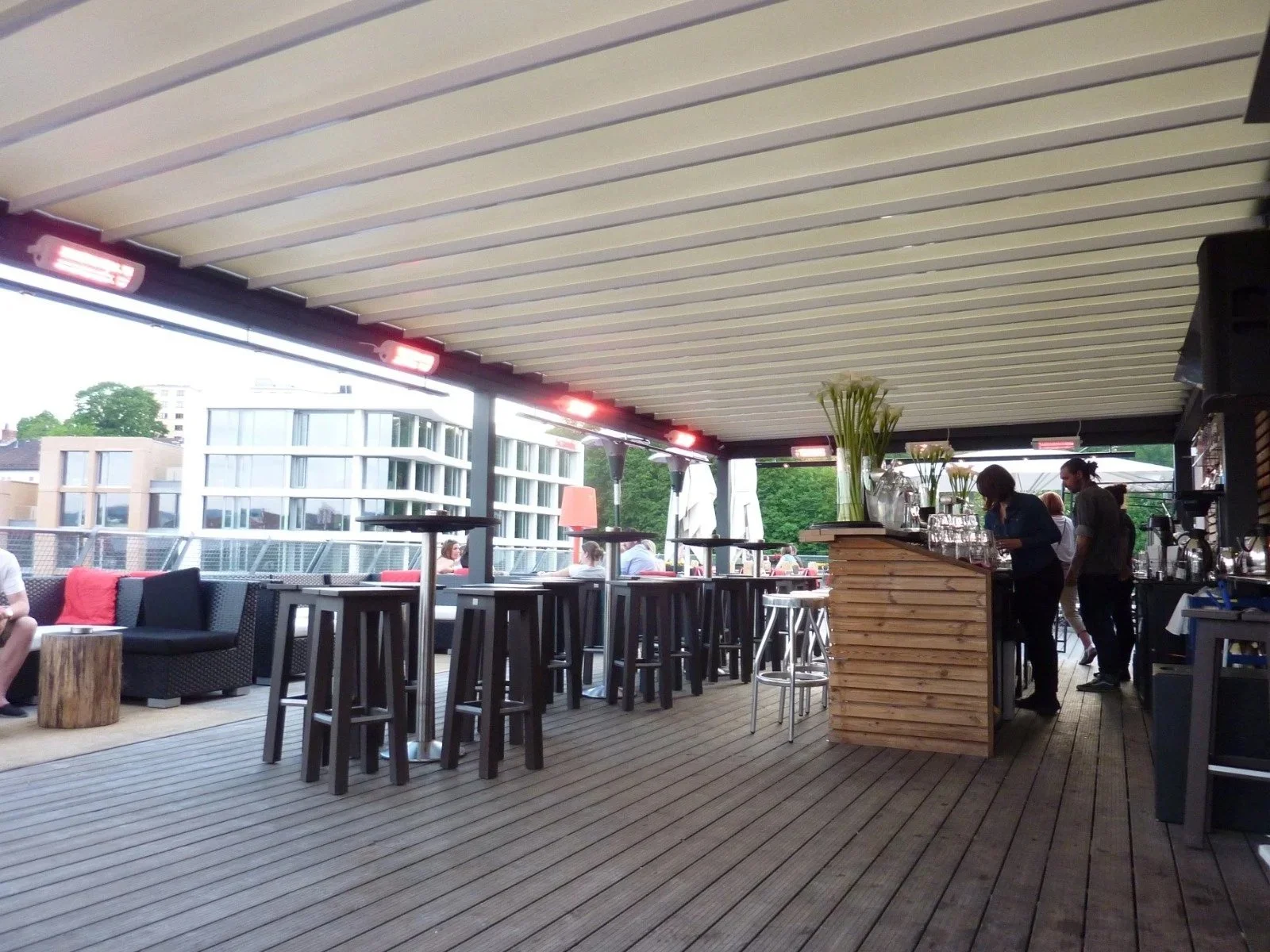
Awning Scape supplies Pratic systems — Fully imported European system with exceptional engineering standards. Our systems carry independent engineering certification, full structural calculations, and Form 15 / Form 12 Queensland compliance documentation. Budget systems, particularly those imported from Chinese manufacturers, typically carry no local product support, no independent engineering certification, and no path to Queensland building compliance documentation. For a commercial venue, that represents a material risk to both your installation and your insurance position.
8. Brisbane Venue Case Studies
Commercial Installation — Brisbane
Sunset Rooftop Bar — Woolloongabba, Brisbane
A rooftop venue installation requiring engineering-certified systems capable of handling elevated wind exposure. Pratic systems were specified for their structural performance at height and their ability to provide full engineering documentation for the venue's building compliance requirements.
Commercial Installation — Brisbane
Ruma — New Farm, Brisbane
A New Farm dining venue where the alfresco system needed to match a premium interior aesthetic while providing reliable all-weather protection. Solution-based specification meant selecting the right product for the design intent of the space, not a standard catalogue system.
Project enquiries
For commercial projects, Awning Scape provides a full design consultation including site assessment, structural feasibility, product recommendation and indicative pricing before any commitment is required.
9. Council and DA Approvals — Brisbane Venues
Council approval requirements for outdoor weather protection systems vary significantly depending on the location and nature of the installation. The following guidance is general — always confirm requirements with Brisbane City Council or a licensed private certifier for your specific site.
Brisbane CBD and street-facing venues
In Brisbane's CBD and high-visibility street corridors, council places greater emphasis on design consistency and the visual impact of structures on the streetscape. Commercial installations in these areas typically require a development application (DA) that demonstrates the system's compliance with local design guidelines. Brisbane City Council will want to understand the materials, colours, dimensions and structural engineering of the proposed system before approval.
Non-street-facing and suburban venues
For installations that are not visible from the public street — a rear courtyard, an internal terrace, or a venue in a suburban area — there is more flexibility and, in many cases, council approval may not be required. Adding a retractable pergola to an existing terrace area that does not constitute a building renovation does not automatically trigger a DA requirement.
Footpath dining permits
Venues with footpath dining permits face additional considerations. Any structure over a public footpath is subject to council approval and specific engineering requirements. Awning Scape can supply the engineering certification and Form 15 / Form 12 compliance documentation required to support a footpath dining permit application.
Our recommendation
Before committing to a system, speak with a local private certifier and get their independent view on what your specific site requires. This is a 30-minute conversation that can save weeks of back-and-forth with council. Awning Scape can refer you to experienced certifiers who work regularly with commercial hospitality fit-outs in Brisbane.
10. Why System Quality Matters for Commercial Venues
A commercial alfresco system is a structural installation at a working venue. It operates in all weather conditions, across multiple services per day, year after year. The difference between a premium-specification system and a budget alternative is not just aesthetic — it is operational reliability, safety, and long-term cost.
| Awning Scape — Premium Systems | Budget / Import Systems | |
|---|---|---|
| Manufacturing | Quality imported systems (Pratic) and locally manufactured options | Typically Chinese, no local manufacturing support |
| Engineering documentation | Full calculations per installation | Blanket manufacturer claims only |
| Queensland compliance | Form 15 + Form 12 available | Not available |
| Wind rating | Up to 100 km/h extended, site-engineered | Unverified, often no independent testing |
| Motors | Major brand motors — full local support | Cheap Chinese motors — no local parts or support |
| Fabrics | Serge Ferrari, Dickson, Sattler, Mehler | No-name fabrics, no UV certification |
| Warranty | 5 years system / 2 years motors | Limited or no commercial warranty |
| Repair and service | Local Brisbane team | No local support — parts unavailable |
11. The ROI Calculation for Hospitality Venues
The business case for a quality alfresco system is straightforward when modelled against revenue risk. Use the following framework for your own venue:
Step-by-step ROI model
Alfresco seat count × average spend per person × turns per service = revenue per service from alfresco
Estimate affected services per year — Brisbane averages 50–80 significant rain days per year during business hours. A conservative estimate is 20–30 services per year meaningfully disrupted by weather.
Revenue at risk per year = revenue per service × affected services
System cost ÷ annual revenue at risk = payback period in years
Most Brisbane hospitality venues see a payback period of 12–24 months on a quality retractable roof or louvre system — before accounting for increased bookings, extended seasonal use, and the ability to take group bookings that specifically require a weatherproof outdoor space.
12. Frequently Asked Questions
What is the best outdoor weather protection system for a Brisbane restaurant?
For full all-weather protection of an outdoor dining area in Brisbane, either a retractable fabric roof system or a motorised louvre roof system is recommended. Both provide reliable waterproofing, are engineered for Queensland wind conditions, and can be motorised with automated weather sensors. Folding arm awnings are not recommended as a primary waterproof solution for dining areas — see our detailed explanation in Section 3 of this guide.
How much does it cost to cover a 60sqm outdoor dining area in Brisbane?
A commercial retractable fabric or louvre roof system for a 60sqm area typically starts from $50,000 installed in Brisbane. Final cost depends on the system type selected, the structural requirements of the site, motorisation, and any additional features such as integrated lighting, heating or automated screens. Awning Scape provides a full design consultation and indicative pricing before any commitment is required.
Do I need council approval to install a retractable roof at my Brisbane venue?
It depends on your location and the nature of the installation. In Brisbane's CBD and street-facing locations, a development application is typically required. In non-street-facing locations — a rear courtyard or suburban venue — approval may not be required. Adding a retractable pergola to an existing terrace does not automatically constitute a building renovation requiring DA. We recommend speaking with a private certifier for a site-specific assessment. Awning Scape supplies Queensland Form 15 and Form 12 compliance documentation to support council applications.
What wind speed can a commercial retractable roof handle in Brisbane?
Awning Scape retractable roof systems carry wind ratings of up to 100 km/h in the extended position, with higher ratings when closed or retracted. Each installation comes with site-specific engineering calculations, not blanket manufacturer claims. We recommend automated wind sensors on all commercial installations, which retract the system automatically when wind speeds approach the safe operating threshold.
Can a folding arm awning provide waterproof protection for outdoor dining?
Not reliably. While folding arm awning fabrics may be technically waterproof, the system does not drain water cleanly in a heavy downpour. Water pools on the fabric then runs off the leading edge, splashing outward by approximately one metre on each side. This makes the seating near the edges unusable in heavy rain and defeats the commercial purpose of the installation. Folding arm awnings are well suited to sun control and light rain for street-side cafés, but are not the right specification for a primary commercial dining enclosure.
What is a bioclimatic louvre roof and is it suitable for hospitality venues?
A bioclimatic louvre roof is a motorised aluminium louvre system where the blade angle can be adjusted to control light, ventilation, shade and rain protection simultaneously. Awning Scape supplies Pratic bioclimatic louvre systems — available in seven models with single modules up to 5.5m wide by 7m projection, which can be linked to cover any size of commercial area. Bioclimatic systems are particularly well suited to hospitality venues because they provide fine environmental control across all seasons — ventilating in summer, sealing against rain in storms, and retaining warmth in winter when paired with infrared heating.
How long does it take to supply and install a commercial system?
Manufacturing lead time is 6–8 weeks from order confirmation. Installation typically takes 1–2 days for retractable roof systems. The full process from initial design consultation to completed installation is typically 8–12 weeks, depending on site complexity and any council approval requirements.
What warranty do Awning Scape commercial systems carry?
All Awning Scape systems carry a 5-year structural warranty and a 2-year warranty on motors. Systems are supplied with full engineering documentation and Queensland building compliance certificates (Form 15 and Form 12) are available on request.
Ready to protect your alfresco dining area?
Awning Scape provides a free design consultation for Brisbane hospitality venues. We'll assess your site, recommend the right system for your design and structural requirements, and provide an indicative price — before you commit to anything.