Retractable Roof Buyer's Guide — Brisbane 2026
A motorised retractable roof turns a standard Brisbane alfresco into a fully weatherproof outdoor room — protecting the space from rain while opening completely to blue sky on demand. This guide explains the two types of retractable roof system, what each costs, how they handle Queensland storms, and the three buying mistakes that end up costing customers far more than they saved.
In this guide:
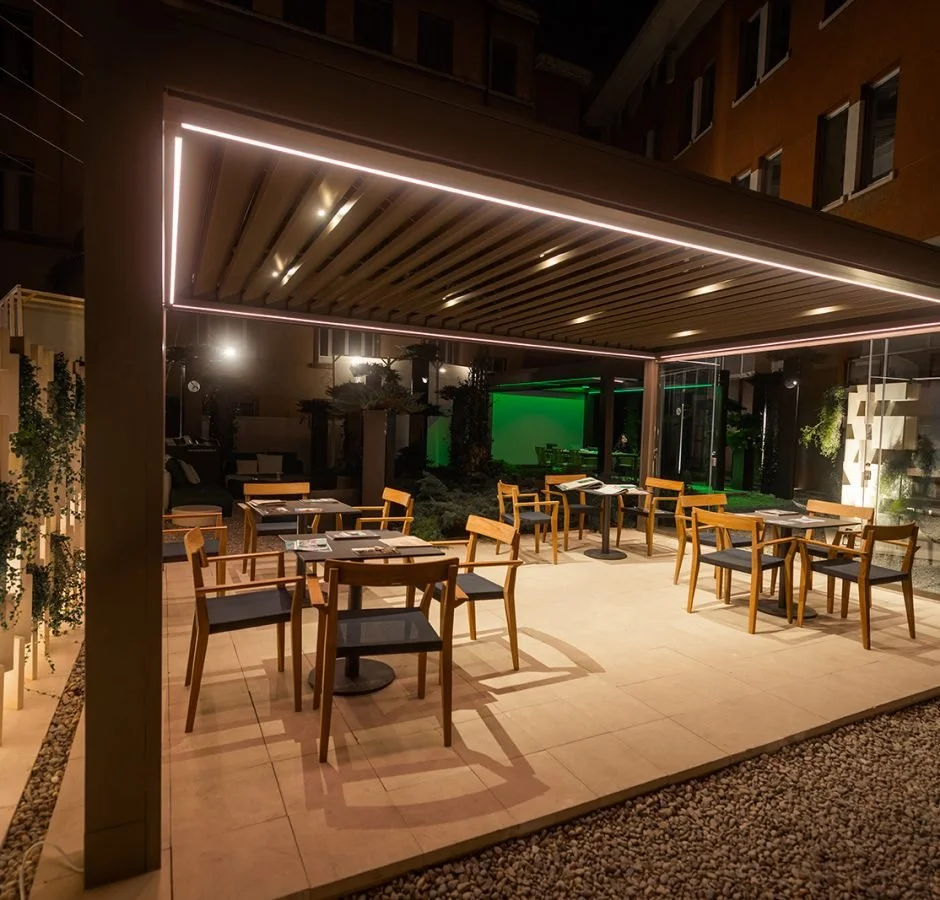
Motorised retractable fabric roof for Brisbane alfresco — Awning Scape
What is a retractable roof system?
A retractable roof is a motorised system that extends a panel — either aluminium louvre blades or waterproof fabric — over an outdoor space and retracts it completely when not needed. There are two fundamentally different products in this category:
Fabric retractable roof: A roll of 100% waterproof PVC fabric extends from a motorised cassette at the wall to the front beam, tensioning over the opening. Awning Scape uses premium fabrics from Serge Ferrari, Sattler, Dickson, and Mehler — all 100% waterproof with high UV ratings. The key performance variable is not the fabric itself (all quality fabrics are waterproof) — it is how the system manages water runoff and drainage. Poor drainage design causes pooling and customer complaints even with premium fabric. The Pratic Rialto fabric system is noted for its superior water runoff and gutter management.
Retractable louvre roof: Motorised aluminium blades retract to expose open sky, tilt for airflow, or close to a watertight seal. This system is approximately 30% more expensive than a fabric retractable but offers unique advantages — particularly the bioclimatic airflow effect that begins the moment blades tilt even 2cm, making hot Brisbane days far more comfortable under a closed roof. See the Louvre Pergola Buyer's Guide for the full comparison and Retractable Awning Guide.
The critical insight on waterproofing: The fabric being waterproof is necessary but not sufficient. The system must be designed for correct fabric tension, pitch, and water runoff to the gutter channel. A quality fabric on a poorly designed system will still result in pooling, drips at fixing points, and unhappy customers. Always ask a supplier to show you the drainage management design — not just the fabric spec sheet.
How much does a retractable roof cost in Brisbane?
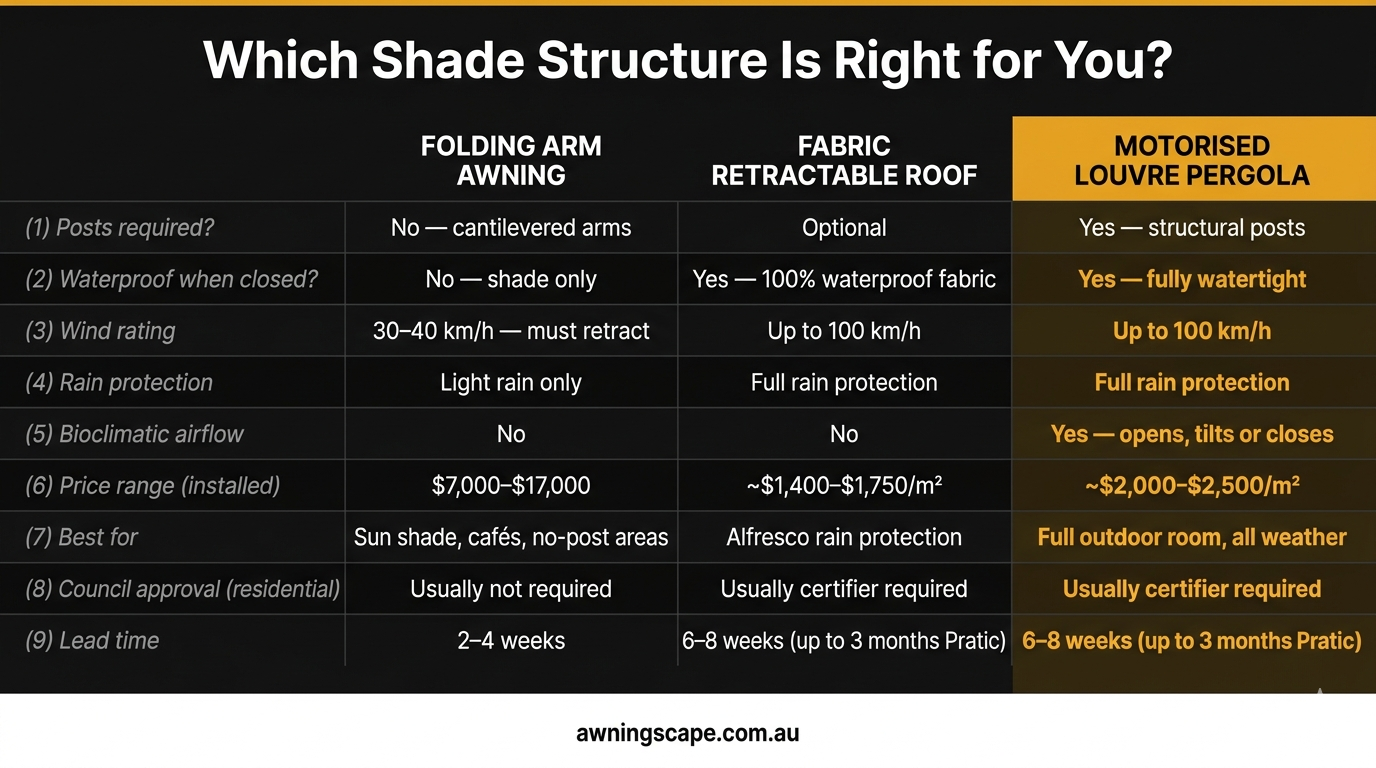
Retractable System Comparison
Fabric retractable roofs offer a significant cost advantage over louvre systems — approximately 30% less — while delivering the same core benefit: full rain protection and full sky access on demand. The trade-off is the absence of airflow control (fabric seals the space when closed, with no bioclimatic ventilation).
Why cheap systems fail
Cheap imported retractable roof systems — typically under $700/m² — consistently fail in three areas: fabric quality (UV degradation within 2–3 years in Queensland conditions), motor reliability (no Australian service when the system fails), and drainage design (water pooling rather than running off cleanly). The upfront saving is quickly consumed by the cost of replacement or the frustration of a system that doesn't deliver what it promised.
Retractable roof vs louvre pergola — which is right for you?
FeatureFabric Retractable RoofMotorised Louvre PergolaFull rain protectionYesYesFull sky when openYesYesAirflow when coveringNo — sealed spaceYes — tilt blades from 2cmMechanism complexitySimpler — fewer moving partsMore complex — blade pivot systemIntegrated optionsLimitedGlass, zip blinds, lighting (Pratic)Cost~30% less than louvreHigherBest forRain protection + sky access, budget priorityAll-weather outdoor room, ventilation critical
Choose a fabric retractable roof if: Your main goal is rain protection for an existing alfresco and cost is a significant factor. You're happy closing off the space entirely in rain and don't need airflow management on hot days.
Choose a louvre pergola if: You want to use the space comfortably on hot Brisbane summer days without air conditioning — the tilt-and-ventilate capability makes a significant difference in liveability. Or you want integrated blinds, glass, or lighting as part of the system design.
Will a retractable roof handle Brisbane's weather?
Rain: Quality fabric retractable roofs are fully waterproof. All fabrics used by Awning Scape — Serge Ferrari, Sattler, Dickson, Mehler — are 100% waterproof with high UPF ratings. Water runoff channels to the front gutter beam and drains away. Proper pitch and tension management is critical — this is the design variable that separates good installations from complaints.
Retractable roof closed in heavy rain — Brisbane storm protection — Awning Scape
Wind: Quality retractable roof systems are rated up to 100 km/h wind load. Awning Scape recommends installing with a wind sensor programmed to auto-retract at approximately 60 km/h — before conditions reach dangerous levels. Commercial note: Auto wind sensors should not be relied on as the sole safeguard when customers are underneath — operators should monitor approaching weather and retract the system manually when a storm is known to be incoming.
UV: Premium fabric brands (Serge Ferrari, Sattler, Dickson, Mehler) provide high UPF sun protection. Standard ratings for quality outdoor fabrics used in shade structures are UPF 50+. Cheaper fabrics degrade and fade significantly faster in Queensland's high UV conditions.
Does a retractable roof need council approval in Brisbane?
The same accepted development rules apply as for other overhead shade structures:
Freestanding, under 10m², max 2.4m height, setbacks met: Generally accepted development — no DA
Attached to the house: Building approval via private certifier almost always required
In a Coastal Hazard, Heritage or Traditional Building Character overlay: DA likely required
Most residential retractable roof systems are attached to the house wall — meaning building approval via a private certifier is the standard process. Expect $2,000–$2,600 for a typical residential certifier fee, with straightforward approvals processed in days to 2–4 weeks. Awning Scape provides engineering drawings (Form 15 ready) for every project.
See the full rules in our Council Approval Guide — Brisbane 2026.
How long does a retractable roof last in Queensland?
There are two components to consider:
Fabric: Quality waterproof fabrics (Serge Ferrari, Sattler, Dickson, Mehler) last 10–15 years in Queensland conditions with reasonable care. UV exposure, cleaning frequency, and how often the system is retracted (vs left extended) all influence lifespan. Cheap fabrics can show significant UV degradation within 2–3 years in Brisbane's high UV environment.
Structure (frame, cassette, motors): The aluminium frame and cassette housing of a quality system is designed to last 15–20+ years. Motors carry a 2-year warranty; European-brand motors (Somfy, Teleco) typically last much longer with normal use. The structural warranty across quality brands is 5 years.
Coastal environments reduce lifespan for all components without a regular fresh-water maintenance programme. See the Coastal & Bayside Retractable Systems Guide for full maintenance details.
What to look for — and the top 3 buying mistakes
Mistake 1 — Buying a cheap online system and expecting it to perform
A $5,000–$10,000 cheap retractable roof system typically fails within 2–3 years in Queensland conditions — UV-degraded fabric, motor failure with no local service, and drainage that pools rather than sheds. The upfront saving is quickly reversed. Quality fabric retractable roofs start from approximately $28,000 for a typical 4m × 5m alfresco installed by an experienced team.
Mistake 2 — No 3D model or construction plans before installation
Many installers work from rough measurements and brochures only. A proper supplier provides construction drawings AND a 3D render so you understand exactly what is being installed — drainage routing, post positions, cassette placement, fabric colour — before a single hole is drilled. Awning Scape produces both on every project. If a supplier can't show you a 3D model, treat that as a risk signal.
Mistake 3 — Choosing a supplier who doesn't understand drainage design
The most common cause of unhappy customers with retractable roofs is not fabric quality — it's water management. Improper pitch, incorrect tension, or poor drainage channel design causes pooling, dripping at fixing points, and structural fatigue. Ask every supplier to explain specifically how the water leaves the system. If the answer is vague, keep looking.
Ready to get a price on a retractable roof?
Awning Scape supplies both the Pratic Rialto fabric system and quality Australian-branded retractable roofs across Brisbane. Free measure, 3D render, and full quote with no obligation. Premium systems. Local team. 3D render included.
Frequently asked questions — retractable roof Brisbane
Are retractable roofs waterproof or just for shade?
Quality motorised retractable roofs are fully waterproof. Awning Scape uses premium PVC fabrics from Serge Ferrari, Sattler, Dickson, and Mehler — all 100% waterproof. The key variable is not the fabric itself but the drainage design: how water is managed from the fabric surface to the gutter and away from the space. Poor drainage causes pooling even with quality waterproof fabric.
How much does a retractable roof cost per square metre?
Quality fabric retractable roofs in Brisbane are installed from approximately $1,400 per m². The Pratic Rialto system via Awning Scape is approximately $1,750/m². Cheap imported systems are available under $700/m² but carry significant risks: UV degradation within 2–3 years, inadequate waterproofing, and no Australian motor service. A typical 4m × 5m (20m²) quality installation costs $28,000–$35,000.
Do you need council approval for a retractable roof in Queensland?
Not always. Freestanding structures under 10m² with maximum 2.4m height that meet BCC setback requirements are accepted development — no DA required. Structures attached to the house almost always require building approval via a private certifier, regardless of size. Properties in Coastal Hazard or heritage overlay zones are subject to additional approval requirements.
Is a retractable roof better than a louvre pergola?
Neither is objectively better — they serve slightly different needs. A fabric retractable roof is approximately 30% less expensive and provides identical rain protection and open-sky access. A louvre pergola adds the ability to tilt blades for airflow on hot days, making the space usable on Brisbane's humid summer days without being completely sealed. If ventilation on hot days is important, the louvre system is the better choice at higher cost.
Can a retractable fabric roof withstand strong winds?
Yes. Quality retractable fabric roof systems are rated up to 100 km/h wind load. Awning Scape recommends adding a wind sensor programmed to auto-retract at approximately 60 km/h to protect the system before dangerous conditions develop. For commercial installations with people underneath, manual monitoring and retraction before known storms is also recommended alongside automatic sensors. Also Review the Retractable Roof Buyers Guide.
How long does a retractable roof last in Australia?
Quality fabrics (Serge Ferrari, Sattler, Dickson, Mehler) last 10–15 years in Queensland conditions with reasonable care. The aluminium frame and cassette housing are designed for 15–20+ years. The 5-year structural warranty and 2-year motor warranty are industry standards across reputable brands. Coastal environments require a regular fresh-water washdown programme to maintain system life and warranty coverage.