Louvre Pergola Buyer's Guide — Brisbane 2026
A motorised louvre pergola is the most versatile outdoor living structure available for a Brisbane home. Open the blades for full sky. Close them for a watertight storm shelter. Tilt them 2 centimetres and the bioclimatic airflow begins — making the space significantly cooler without losing shade. This guide covers pricing, brand comparisons, drainage, council approval rules, and what separates a quality system from a costly mistake.
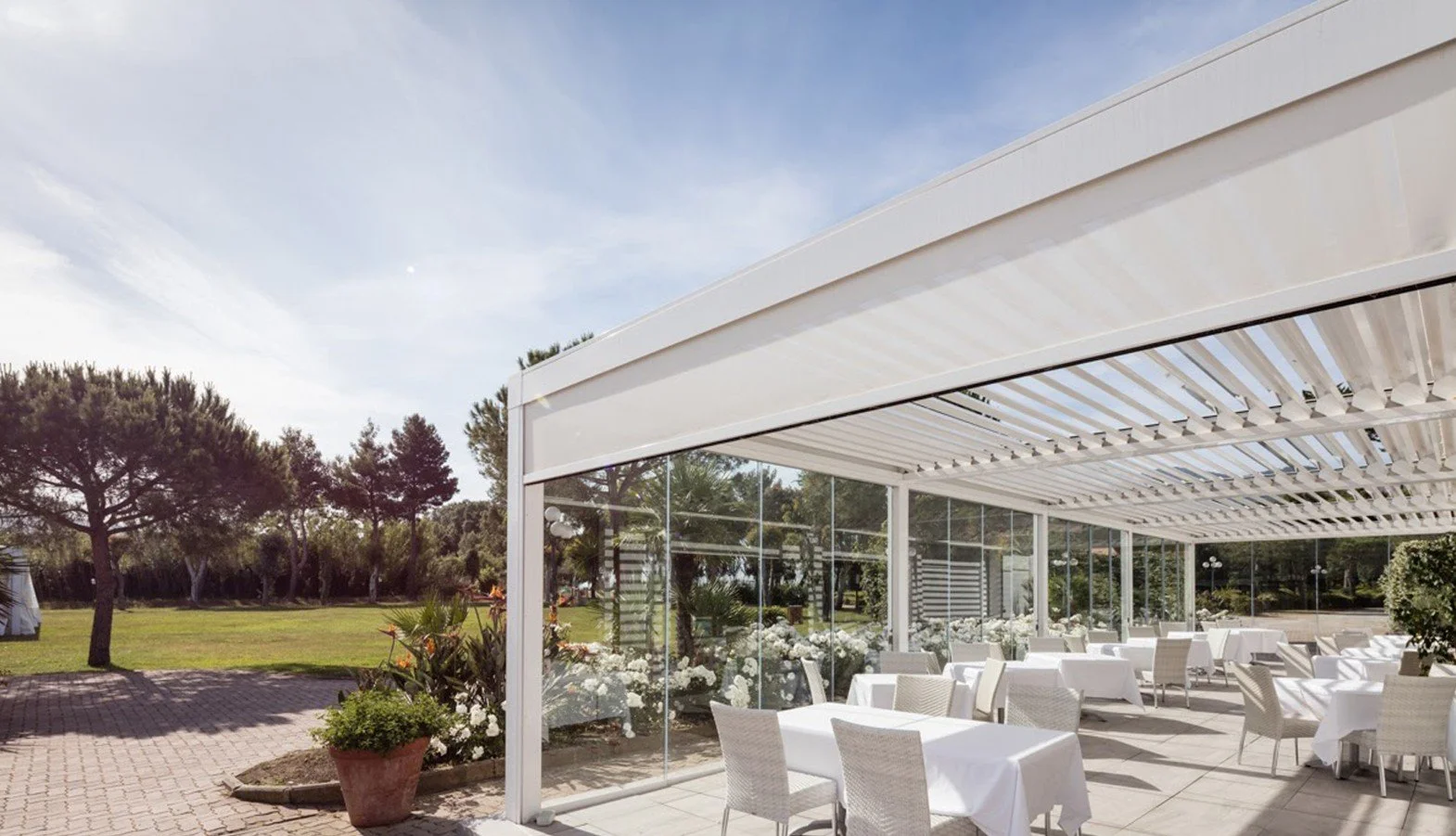
Tiling Louvre System
In this guide:
Pratic motorised louvre pergola installed on a Brisbane home — Awning Scape
What is a motorised louvre pergola?
A motorised louvre pergola is a permanent aluminium-framed structure with adjustable aluminium blades that open, close, and tilt on a motorised axis. Unlike a fixed patio roof, it gives you full control over sun, airflow, and rain protection from a remote control or smartphone.
Three operating positions cover every Brisbane weather scenario:
Open (0°): Blades retract, exposing full sky — maximum light and open-air feel
Tilted: Blades filter sun and direct breeze. The bioclimatic effect begins at just 2cm of tilt — hot air rises through the gaps, dramatically cooling the space beneath while shade is maintained
Closed (horizontal): Blades seal watertight — full rain protection over the space below
The major brands in the Australian market are Vergola (the Australian pioneer — the name is now synonymous with louvre roofs, similar to Hoover for vacuum cleaners), Louvretec (New Zealand-founded, spiral pivot mechanism, extruded blades), and Pratic (Italian, ~64 years of louvre manufacturing history, exclusive to Awning Scape in Brisbane). All reputable systems use Somfy or Teleco motors — European-grade with local Australian service support.
How much does a louvre pergola cost in Brisbane?
Installed prices in Brisbane vary significantly by system tier:
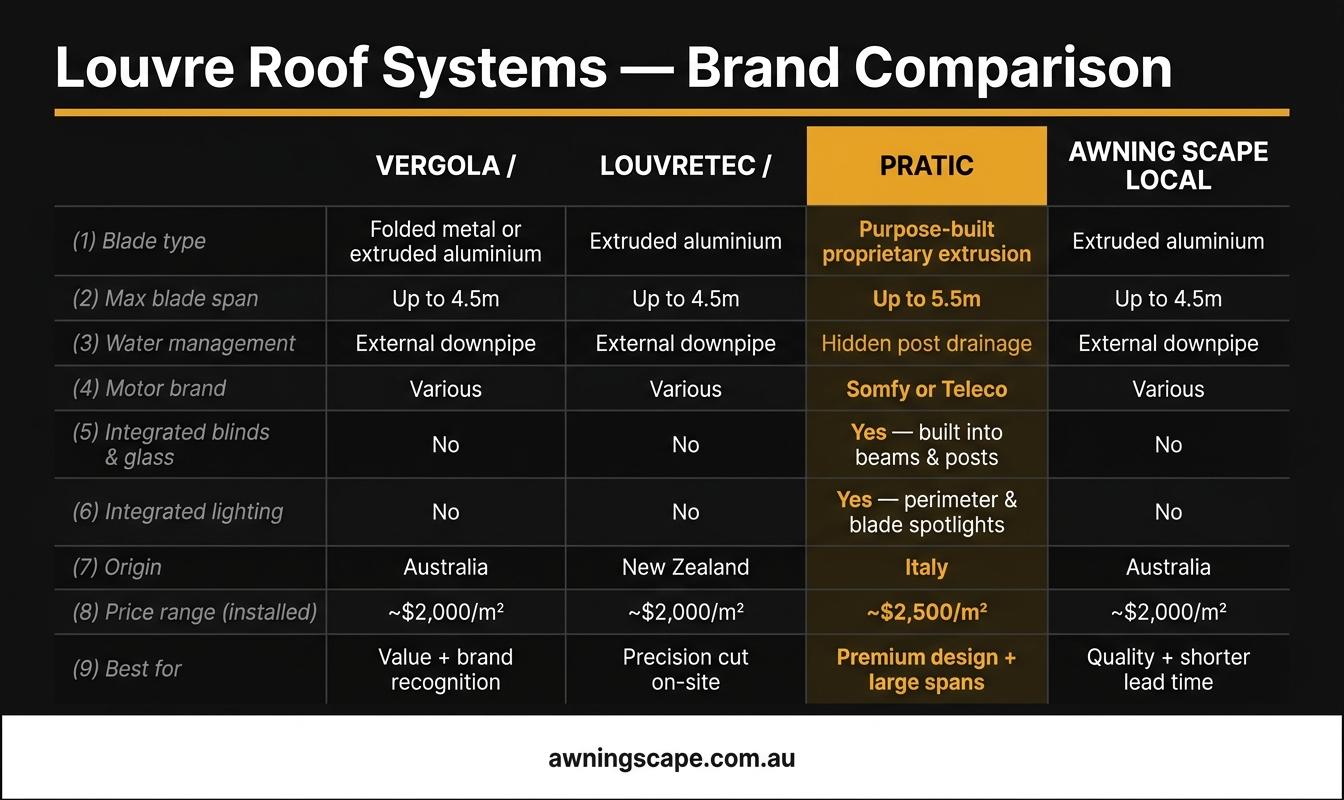
What drives the price difference?
The gap between quality systems and cheap imports is not about brand names — it reflects engineering differences that matter in Queensland conditions. Pratic spans up to 5.5m wide without a centre post (vs 4–4.5m on Australian brands). Its drainage routes water through channels cut into each blade, through the beam, and down the hollow post — eliminating external downpipes and gutter splash. And it is the only louvre system on the Australian market with glass and zip blinds integrated directly into the structural posts and beams, plus integrated perimeter and blade spotlights built into the system.
Warranty across all reputable brands: 5 years structural / 2 years motors. Cheap imported systems typically carry no meaningful Australian warranty and no local service when a motor fails — meaning the system becomes unusable with no path to repair.
Louvre pergola vs retractable fabric roof — key differences
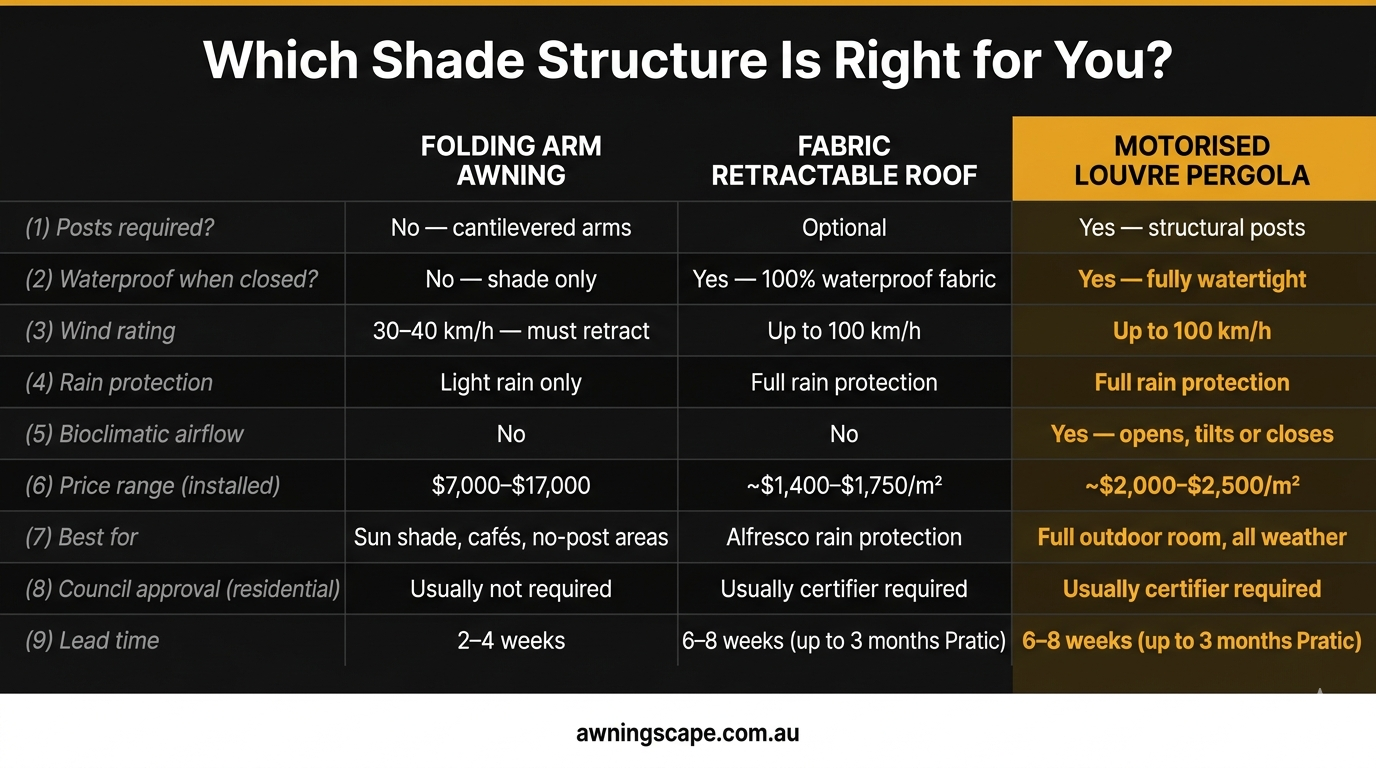
Awning - Fabric Retractable Roof - Louvre Roof Comparison
Awning Scape guidance: If you want a permanently liveable outdoor room that stays comfortable on hot Brisbane days without air conditioning — a louvre pergola is the right choice. If your main goal is rain protection for an alfresco and budget is a constraint — a quality retractable fabric roof delivers at approximately 30% less cost.
Are louvre roofs waterproof? Handling Brisbane storms and rain
Yes — quality motorised louvre systems close to a fully watertight seal when blades rotate to the horizontal position. The question is not whether they're waterproof, but how well they manage that water in heavy Queensland rain.
Standard Australian systems: Water runs off blade ends into a perimeter gutter, which requires external downpipes to drain. In heavy rain, water can splash out of the gutter before it reaches the downpipe — compromising the waterproof protection you paid for.
Pratic system: Deep channels cut into each blade carry water along its full length to a long end-section, which channels water down the blade end (not across) into the structural beam. The beam routes water through the hollow post to a drainage point at the base. No external downpipes. No splash. No gutter overflow.
Louvre pergola waterproof when closed — Brisbane rain protection — Awning Scape
Heat management: Aluminium blades absorb and conduct heat when closed. Dark powder coat colours (anthracite, charcoal) absorb significantly more heat than white or silver. Pratic offers foam-injected blades as an option — significantly reducing heat conduction. In practice, on a hot Brisbane day blades are typically open or tilted — they close automatically only if rain is detected. The bioclimatic effect begins immediately at 2cm of tilt, introducing airflow that rapidly drops the temperature under the structure.
Wind: Pratic systems are rated for very high wind loads — comparable to Louvretec, which is regarded as one of the highest-rated systems in Australia. All systems installed in Brisbane should carry Form 15 engineering certification from an RPEQ (Registered Professional Engineer of Queensland) confirming wind load compliance for the specific site and wind region.
Does a louvre pergola need council approval in Brisbane?
It depends on size, how it's attached, and whether your property is in an overlay zone. The practical framework:
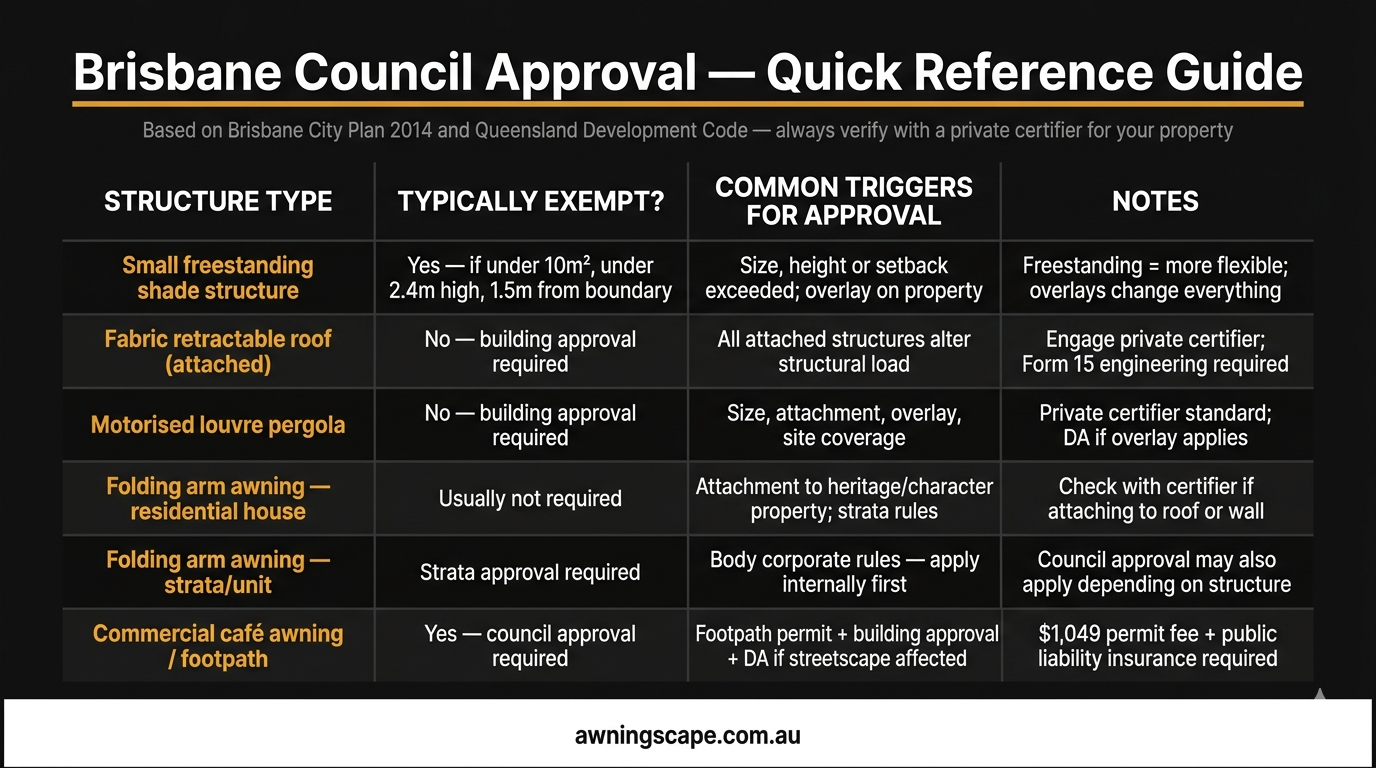
Brisbane Council Guide for Retractable Structures Approval
Most Awning Scape installations are attached to the home — which means building approval via a private certifier is the standard path. The certifier requires Form 15 (engineering design certificate from an RPEQ) and issues Form 12 inspection certificates at each construction stage.
Costs and timeline: Private certifier fees typically $2,000–$2,600 for residential projects. Straightforward approvals can be issued within days to 2–4 weeks. Check your overlay status at BCC City Plan online before committing to a size or boundary position.
Awning Scape provides construction drawings and technical documentation to support your certifier or council application. The application itself is the homeowner's responsibility — AS cannot make compliance determinations for individual properties.
For the full guide to Brisbane approval rules, see our Council Approval for Retractable Pergolas & Motorised Roofs — Brisbane 2026.
Choosing the right louvre pergola — what to look for
Ask these five questions at any supplier consultation before signing:
What is the maximum module span without a centre post? — Australian brands max out at 4–4.5m wide. Pratic spans up to 5.5m. For decks wider than 4.5m, this determines whether you'll have a post in an inconvenient or obstructive location.
Does drainage run through the posts or via external downpipes? — External downpipes indicate the system relies on gutters alone. Post-integrated drainage (Pratic) eliminates splash and external hardware for a cleaner aesthetic and superior performance.
Is the frame a proprietary system or cut Australian extrusions? — All Australian brands use cut aluminium extrusions mitred and screwed together. Pratic uses a custom-designed proprietary aluminium frame purpose-built for louvre systems — the engineering difference is significant for long spans and storm-rated wind loads.
What motors are fitted? — Somfy and Teleco are the leading European motor brands with Australian service support. Unknown Chinese motors cost less at purchase but carry significant risk — a failed motor on an unsupported brand means the system cannot operate and there is no repair path.
Will you provide a 3D render and construction drawings before we commit? — Any professional supplier should produce both before you sign. Awning Scape does this on every project. If a supplier is working off brochures and rough measurements, that is a risk indicator for both design quality and installation accuracy.
Common louvre pergola problems — and how to avoid them
Problem 1 — Water getting through in heavy rain
Almost always a cheap imported system with inadequate blade seal or poor drainage design. Quality systems (Vergola extruded, Louvretec, Pratic) do not leak when closed. Ask the supplier to explain the drainage path from blade to ground before purchasing — if they can't describe it clearly, that's a warning sign.
Problem 2 — Motor failure with no local service
The single most common complaint category in online reviews. A motor fails and the company that installed it operates overseas only, or is no longer trading. Insist on Somfy or Teleco motors and a supplier with an established Australian service team.
Problem 3 — Buying Vergola's folded metal system thinking it's the extruded version
Vergola's original folded-metal blade system has been available for decades — it provides shade but is less effective at rain management than extruded aluminium blades. Vergola now also manufactures an extruded aluminium system. The two products are very different in price and performance. Confirm exactly which Vergola system you're being quoted before signing.
Problem 4 — Corrosion in coastal environments
Any system — regardless of brand or price — installed near the coast or bay without a regular fresh-water washdown routine will corrode. This is a maintenance requirement, not a product failure. Daily hose-down when watering plants; weekly wipe-down of blades and fixings. See our Coastal & Bayside Retractable Systems Guide for the full programme.
Problem 5 — Buying the wrong category of product
A folding arm awning is not a louvre pergola. A retractable fabric roof is not a louvre pergola. A quality consultant identifies your actual need — year-round outdoor room vs seasonal shade vs rain cover — in the first conversation and recommends accordingly. Being sold the wrong category is avoidable and expensive to fix after installation.
Get a price on a Pratic louvre pergola — exclusive to Awning Scape in Brisbane
Awning Scape imports the Pratic system directly from Italy. Every project includes a free site measure, consultation, 3D render, and full construction documentation. Italian engineering. Queensland-certified installation.
Frequently asked questions — louvre pergola Brisbane
Are louvre roofs waterproof in heavy rain?
Yes. Quality motorised louvre systems seal watertight when blades close to the horizontal position. The Pratic system routes water through channels cut into each blade, down into the structural beam, and through the hollow post to a drainage point at the base — eliminating external downpipes and gutter splash-back. Cheap imported systems typically cannot achieve a genuine watertight seal and leak under real rain load.
How much does a louvre pergola cost in Australia?
Installed prices in Brisbane range from approximately $2,000 per m² for quality Australian-branded systems (Vergola, Louvretec, AS local brand) to $2,500 per m² for the Pratic imported system. A typical 4m × 5m (20m²) alfresco costs $40,000–$50,000 installed. Cheap imported systems are available under $1,000/m² but carry significant risks: inadequate waterproofing, no Australian service, and motor failure with no repair path.
Do you need council approval for a louvre roof in Queensland?
Not always. Under BCC City Plan, a freestanding structure under 10m², maximum 2.4m height, meeting setback requirements (1.5m side/rear, 6m front) generally qualifies as accepted development — no DA required. Structures attached to the house almost always require building approval via a private certifier. Properties in Coastal Hazard, Heritage or Traditional Building Character overlay zones likely require a full Development Approval.
Can you install a louvre pergola on an existing deck?
Yes, in most cases. Posts must be fixed to structural footings below the deck — not just the deck surface — and the deck structure must be confirmed capable of carrying the additional load. An engineer's Form 15 certification is typically required. Awning Scape provides construction drawings and structural specifications for every project to ensure the installation is correctly engineered.
Are motorised louvre roofs worth the money?
For year-round outdoor living in Brisbane, yes. A quality louvre system converts outdoor space into an all-weather room that opens fully to sky, runs on automation, and lasts 15–25+ years structurally. The cost premium over a fabric retractable roof is approximately 30%, but it adds airflow control on hot Brisbane days, integrated options including lighting and blinds, and the ability to use the space comfortably in both summer heat and subtropical storms.
How long do aluminium louvre systems last?
Quality aluminium louvre systems carry a 5-year structural warranty and typically last 15–25+ years with normal maintenance. Motors carry a 2-year warranty. In coastal environments, regular fresh-water washdown is essential — marine environments reduce warranty coverage across all brands. The biggest longevity risk is not the aluminium frame — it is motor quality and drainage design. Cheap motors and poor drainage fail far sooner than the structure itself.
Is a louvre roof worth the money?
If you use your outdoor space regularly through Brisbane's seasons — including humid summers and subtropical afternoon storms — a motorised louvre system is the only permanent structure that handles all conditions from one control. It eliminates the choice between going inside when it rains, staying out of direct sun, or suffering the heat of a closed solid roof. For occasional use or tighter budgets, a retractable fabric roof is a strong alternative at approximately 30% less cost.
How long do motorised louvres last?
The aluminium frame and blades of a quality louvre system are designed to last 15–25+ years. The motorised components — the most vulnerable part of the system — carry a 2-year warranty, with quality European motors (Somfy, Teleco) typically lasting much longer with normal use. Motor longevity depends on the brand quality, usage frequency, and whether the system is exposed to coastal conditions without regular maintenance.