Louvre Roof vs Retractable Roof: Which Is Right for Your Outdoor Space?
It's the question every homeowner and hospitality operator eventually asks: should I go with a louvre roof or a retractable roof?
Both systems do the same job on the surface — they give you control over your outdoor environment. But they work differently, suit different applications, and carry different investment levels. Choosing the wrong one isn't just a financial mistake; it's a livability mistake you'll be reminded of every time you use (or avoid) the space.
This is the clearest head-to-head comparison available for the Brisbane and South East Queensland market.
The Quick Answer
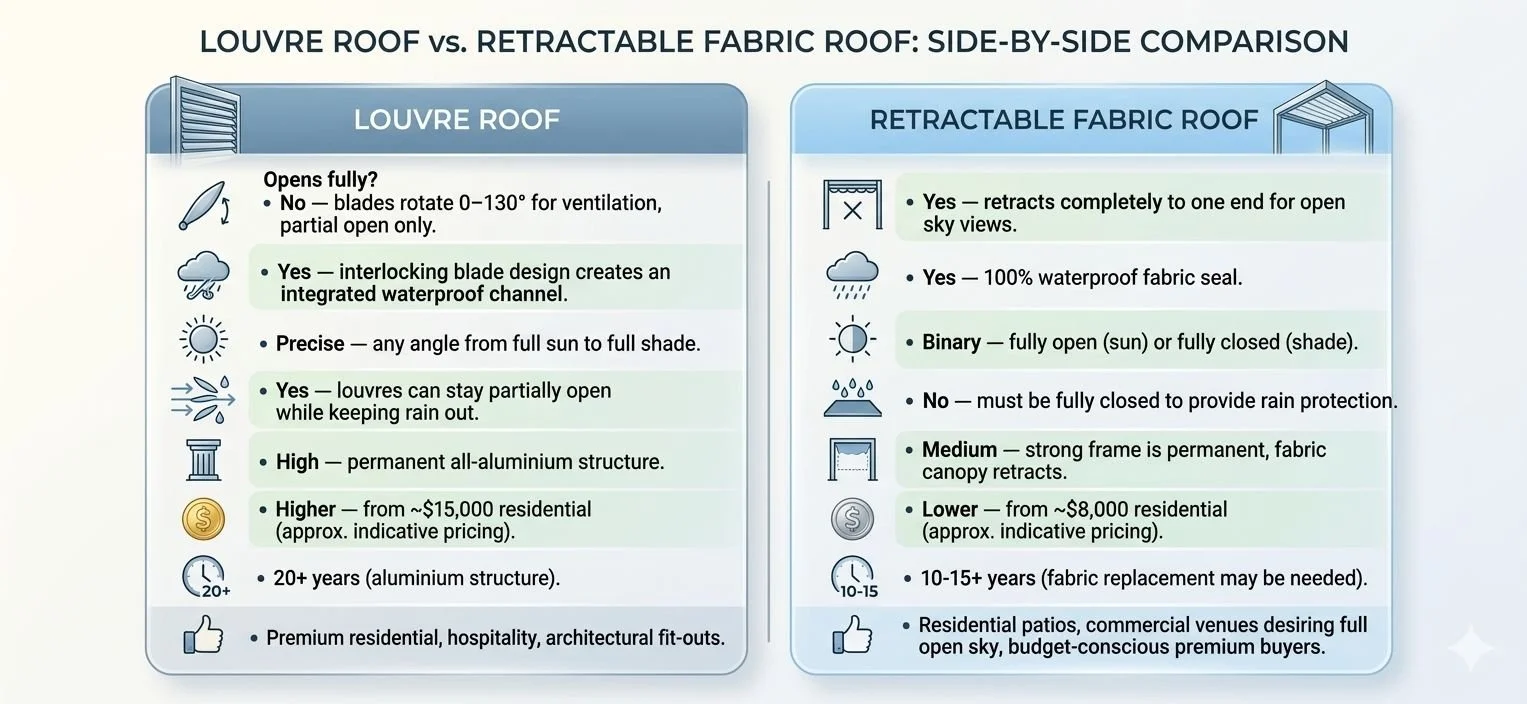
Quick answer comparision chart for louvres vs fabric roofs systems
How a Louvre Roof Works
A louvre roof — also called an opening louvre system or bioclimatic pergola — consists of motorised aluminium blades mounted within a rigid aluminium frame. The blades rotate on a central axis, controlled by a remote or smart device. At 0° the blades are horizontal and the roof is fully closed and watertight. As they rotate toward 130°, progressively more light and air enters the space.
The blade design is key: the tapered top surface creates a channel that directs rainwater to the frame gutters even when the louvres are partially open. This is what allows you to sit under a louvre roof on a rainy afternoon with the louvres slightly open for airflow — and stay dry.
The aluminium structure is permanent. It doesn't retract. When the weather is perfect, you have maximum openness — but not full sky exposure the way a fabric system gives you.
See full technical specifications: Opening Louvre Roof Brisbane
How a Retractable Fabric Roof Works
A retractable fabric roof uses a motorised or manual mechanism to extend a waterproof fabric membrane over a structural frame. When the roof is fully extended, it creates a watertight barrier above the space — blocking sun, UV radiation, and rain completely. When retracted, the entire fabric rolls or folds back into a compact cassette housing at one end, leaving the space fully open to the sky.
The key advantage: when you want open air, you get genuinely open air. No framework in your sightline. No filtered light. Just sky.
The key limitation: the transition between closed and open is binary. You're either shaded or you're not. There's no in-between adjustment for partial shade or directed light.
See full technical specifications: Retractable Roof Brisbane
When a Louvre Roof is the Right Choice
Choose an opening louvre system if one or more of these applies:
• You want year-round daily use of the space. Louvre systems are genuinely all-weather. You can adjust light on a bright winter morning, stay dry during a passing shower, and ventilate on a warm evening — all without changing the position of anything except the blade angle.
• The aesthetic matters as much as the function. Louvre systems are architecturally finished products. Clean aluminium lines, powder-coated in any colour, integrated LED lighting options, flush drainage — they look like they belong to the building rather than being attached to it.
• You're in hospitality. For restaurants, bars, and event venues, a louvre roof creates a controllable environment that can be productively used in a wider range of weather conditions. The atmosphere it creates — especially with integrated lighting — is a product in its own right.
• You have a premium residential project. For high-end residential renovations where the outdoor space is part of the architectural brief, a louvre system integrates at a level that a fabric roof typically can't match.
When a Retractable Fabric Roof is the Right Choice
Choose a retractable fabric roof if one or more of these applies:
• Full sky exposure is part of the experience. If your patio, rooftop, or courtyard is at its best when completely open — and you want the option to cover it quickly when it rains — a retractable fabric system is the only product that gives you both without compromise.
• Budget is a constraint. Fabric retractable roofs are available at lower price points than equivalent-size louvre systems. They remain premium products — but the entry point is lower for the same covered area.
• The space is residential and primarily used seasonally. If your outdoor area is mainly used on summer evenings and weekends, and you want sun protection and occasional rain cover rather than year-round daily use, a fabric system is a pragmatic, cost-effective solution.
• You want the option to maximise natural light in winter. With the roof retracted on a sunny Brisbane winter morning, you get full, unfiltered warmth into the space. Louvre systems let in filtered light — fabric retractables let in everything.
What About a Retractable Pergola System?
For larger, more complex projects — particularly commercial venues, architects, and multi-span installations — a retractable pergola system combines structural engineering with retractable cover in a single integrated product. See our Retractable Pergola Systems Brisbane page for the full range.
The Decision in One Question
Ask yourself: when the weather is perfect in Brisbane — warm, clear, a light breeze — do you want your outdoor space to feel open to the sky, or do you want precise control over light and shade?
If your answer is open to the sky, a retractable fabric roof is probably the right choice.
If your answer is precise control, a louvre roof is probably the right choice.
Both are premium systems when properly specified and installed. The mistake most buyers make is comparing price before comparing function — and ending up with a system that doesn't do what they actually need it to do.
SPEAK TO A SPECIALIST: AwningScape installs both systems across Brisbane and South East Queensland. We'll assess your site and tell you honestly which product suits your application — not whichever has the better margin. Call 0403 999 988 or get in touch via our louvre roof or retractable roof pages.